
There is a bigger threat to landlords that’s not the Renters Rights Bill!
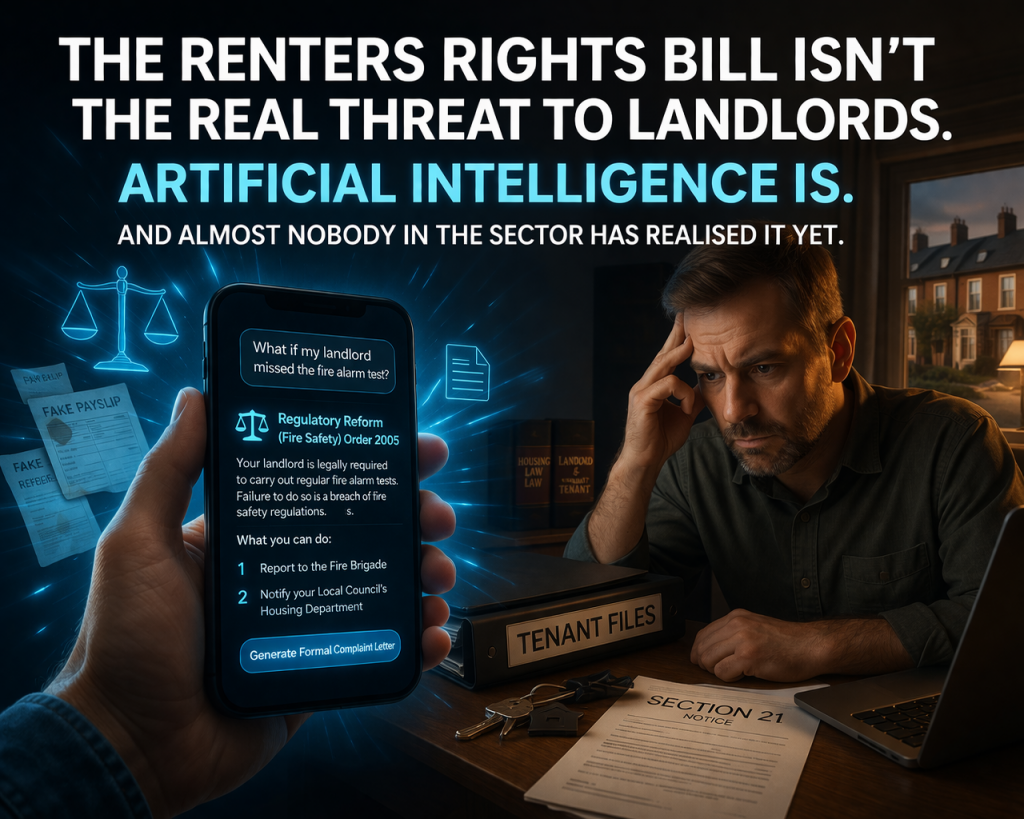
The Renters Rights Bill is not the real threat to landlords. Artificial Intelligence is. And almost nobody in the sector has realised it yet.
Westminster has spent years obsessing over Section 21 and Renters Rights Bill Landlords have pushed back with the obvious warnings about red tape and clogged courts. But while everyone argues about legislation, something far more powerful has slipped quietly into every tenant’s pocket. The real shift isn’t legal. It is technological. It is informational. And it is happening right now.
The situation: AI now gives tenants the legal firepower of a housing expert instantly, for free. A tenant can type “what if my landlord missed the fire alarm test?” and receive a page of polished legal analysis under the Regulatory Reform (Fire Safety) Order 2005, complete with instructions on how to escalate to the Fire Brigade and the Council.
That is a bigger power shift than anything Parliament has ever passed.
Landlords have always feared one archetype: the “professional tenant” who knows how to fake references, stall evictions, exploit procedures and live rent-free for months while pretending to be the victim. Their weakness was always cost and competence. They couldn’t justify hiring lawyers. They eventually made errors.
Now? Any tenant can get advise that reads like it came out of a Chambers on Chancery Lane. Residential law is relatively simple, and AI can strip away the informational advantage landlords once held against rogue tenants. Add in the increased difficulty in under the Renters Rights Bill to evict, it shows the importance of FBI-style referencing has never been greater.
A contractor of mine recently arrived a day early. The contractor made a minor diary mistake. The tenant responded with a letter stating her rights of Quiet Enjoyment under Protection from Eviction Act 1977 drafted with the precision of a Housing Barrister who would normally charge £500 for the privilege. It was created by AI in seconds.
She turned out to be perfectly reasonable when I rang her to explain the mistake, but the message was loud and clear: tenants now can now generate lawyer quality letters with a click. AI makes complaints effortless. These tools can recommend next steps, including how to escalate to the Housing Ombudsman.
AI systems have confirmation bias is built in and it can easily make tenants feel a sense of righteousness. If AI is prompted with one side of the story misses the nuances of a situation. AI is like a supportive friend who will always take your side. The systems also hallucinate: inventing laws, fabricating case names, Judges in the US have already sanctioned lawyers for submitting AI-generated citations that were entirely fictional. If trained professionals fall for it, what chance does an angry tenant in a house share have?
Landlords should expect more minor matters to become Ombudsman complaints and associated workload will increase. For professionals who do a genuinely good job and follow the law it should not create major issues, just more workload. On the plus side AI tools allow property professional quick responses to concerns, gone are the days when I had to draft what I wanted to say and then re-draft for tone when dealing with a tricky tenant.
Fake employer letters, payslips and references have plagued the industry for years. I’ve seen some painfully bad attempts, like the “CEO” supposedly earning £90,000 a year who applied for a HMO room, only for Companies House to reveal he’d registered his “company” the day before.
AI has turned dodgy photoshopped documents into a professional operation though. The FT has already exposed software that produces fake receipts so realistic they come with artificial coffee stains and creases to mimic wear. Tenants can now generate flawless payslips and bank statements in seconds. No typos. No formatting errors. No obvious tells.
This is going to force landlords into FBI-level verification. Every reference must be checked. Emails must come from genuine corporate domains. Bank statements and employment letters will have to be validated independently. Ironically, landlords will end up using AI to detect AI. The AI referencing arms race has already begun.
Despite the risks, AI can give professionals a Teflon coat. A Teflon coat of being ultra professional. AI has helped me dig into updates to Fire Safety law, interrogate guidance and identify details. It has cost me a lot money on some improvements, but I consider it money well spent when tenants can challenge you with weaponised legal language at any moment. The need to follow every nuance of the law has never been more important and AI can give clarity on the ever-increasing regulatory environment.
AI even helped me draft a guarantor clause in a commercial lease, a task I would normally pay a solicitor £1,500 to write. By testing, challenging and iterating, I now understand the nuances of a legally sound commercial guarantor clause better than before. Not only did I save money, I learnt a lot, even as an 11 year veteran. AI as a learning tool is vastly underrated.
The gap between amateur landlords and professionals is about to become a canyon. That may be the best outcome for the sector. There will be nowhere to hide from AI from “Dodgy Daves” running unlicensed, unsafe, poorly maintained properties. Those who follow the law may finally be paid properly for delivering genuinely compliant, high-standard housing.
The Renters Rights Bill shifts the rules.
AI changes the entire game.